
How to Build a Resume in High School (Even Without Job Experience)
Written by Siena Sydenham, GWI Marketing Intern
We’re all familiar with the Job Experience Paradox: you need prior work experience to get a job, but you need a job to get work experience. This may seem an impossible situation, but the truth is it’s not the paid employment, specifically, that is prized; rather, it’s the transferable skills developed through those experiences that are impressive to employers, colleges, scholarship committees, and the professional community at large.
And you can develop those skills everywhere.
Do you volunteer and coach soccer for your local middle school? If so, you are demonstrating a plethora of said desirable traits:
commitment (showing up consistently to a volunteer position)
leadership (encouraging and directing a large group through drills and teambuilding)
adaptability (being flexible and creative to keep the players’ attention) to name a few.
Do you like to read, and so you set up a book club with some friends or a little free library in your neighborhood? If so, you are showcasing:
organizational skills (bringing people together on a shared timeline to achieve a predetermined goal)
community engagement skills (personally working to cultivate relationships)
initiative (building a program from scratch)
As evidenced in these two initial examples, it is possible to build resume-worthy experiences and professional skills from everyday life activities and interests—no paycheck needed.
So, How Do I Start Writing My Resume?
Too often, people discount their abilities and underestimate their experiences when building a resume. In order to avoid that, one of the best ways to approach crafting a resume is to outline all possible sections (e.g., Education, Honors, Volunteer Experience, Leadership Experience, Relevant Skills, Relevant Projects) and list out every experience you’ve had that is even remotely connected to one of these categories. Then:
Record the rough dates of your involvement alongside each.
Go point by point and brainstorm a list of all of the verbs, adjectives, and skills associated with each.
Look for opportunities to sort or conflate experiences into one shared thematic subheading and create 2-4 brief, but active, bullet point descriptions of each activity.
And remember, you’re a high school student; school is a full time job in and of itself, and it can prove to be an incredibly useful starting point as well.
How Do I Include My Schoolwork and Educational Experiences on My Resume?
In addition to the necessary “Education” section, there are countless ways to highlight your schoolwork on your resume, including using subheadings like “Relevant Courses,” “Relevant Projects,” “Relevant Skills,” and “Honors & Awards.”
It is even more valuable to dedicate space in your resume to tangible experiences working on school projects that mirror the structure of a desired job and detail specific opportunities which helped develop a particular, necessary skillset than it is to boast generic work exposure.
For example, if you worked on a semester-long video project covering the Oregon Trail, then you likely demonstrated proficiency in performing robust research and critical analysis in addition to digital editing and multimedia fluency.
While you may not be asked to draw on your particular research or knowledge of the Oregon Trail in an internship or first job experience, you most definitely will need to know how to work on a timeline as well as execute assigned projects. Depending on the job, technical skills like video software editing experience can also be of interest to many employers—take advantage of opportunities to show your versatility and proficiency.
How Can I Incorporate Volunteer Experience on My Resume?
It’s not just schoolwork that can highlight your transferable skills, but any extracurricular activity as well. A section devoted to “Volunteer Experience” shows commitment and motivation to one’s community without any form of monetary compensation. Volunteer experience often shares the expectations of a professional workplace and by showing a dedication to an organization or a community you convey to employers that you take your commitments seriously.
What Place Do Extracurricular Activities Have on a Resume?
Similar to volunteer experience, extracurricular activities that showcase creative problem solving are increasingly important. The Girls With Impact Innovation Academy, one example, guides students through the entrepreneurial process in five weeks allowing them to turn an idea into action with a personalized business development plan and instruction.
“The resources, mentors, and course from Girls with Impact have collectively shaped my academic journey by teaching me the foundation of how to innovate and think in new ways,” GWI alum Ananya Kamboj explained. “The program opened my eyes to entrepreneurship as not just acting on creating a solution, product, or idea, but also as a framework and mindset that I approach in life.”
As Kamboj explains, it’s not just the technical experience of the Innovation Academy that has proved useful, but the framework and mindset that she learned which carries into other aspects of her life. This is exactly the kind of skill, gained through extracurricular experiences, that will translate seamlessly to a workplace.
The experience is perfect for a resume as students take away tangible experience and project development skills they can talk about and continue to build on. Each student also earns a micro-credential for their LinkedIn and resume—a well respected form of certification for completing the program.
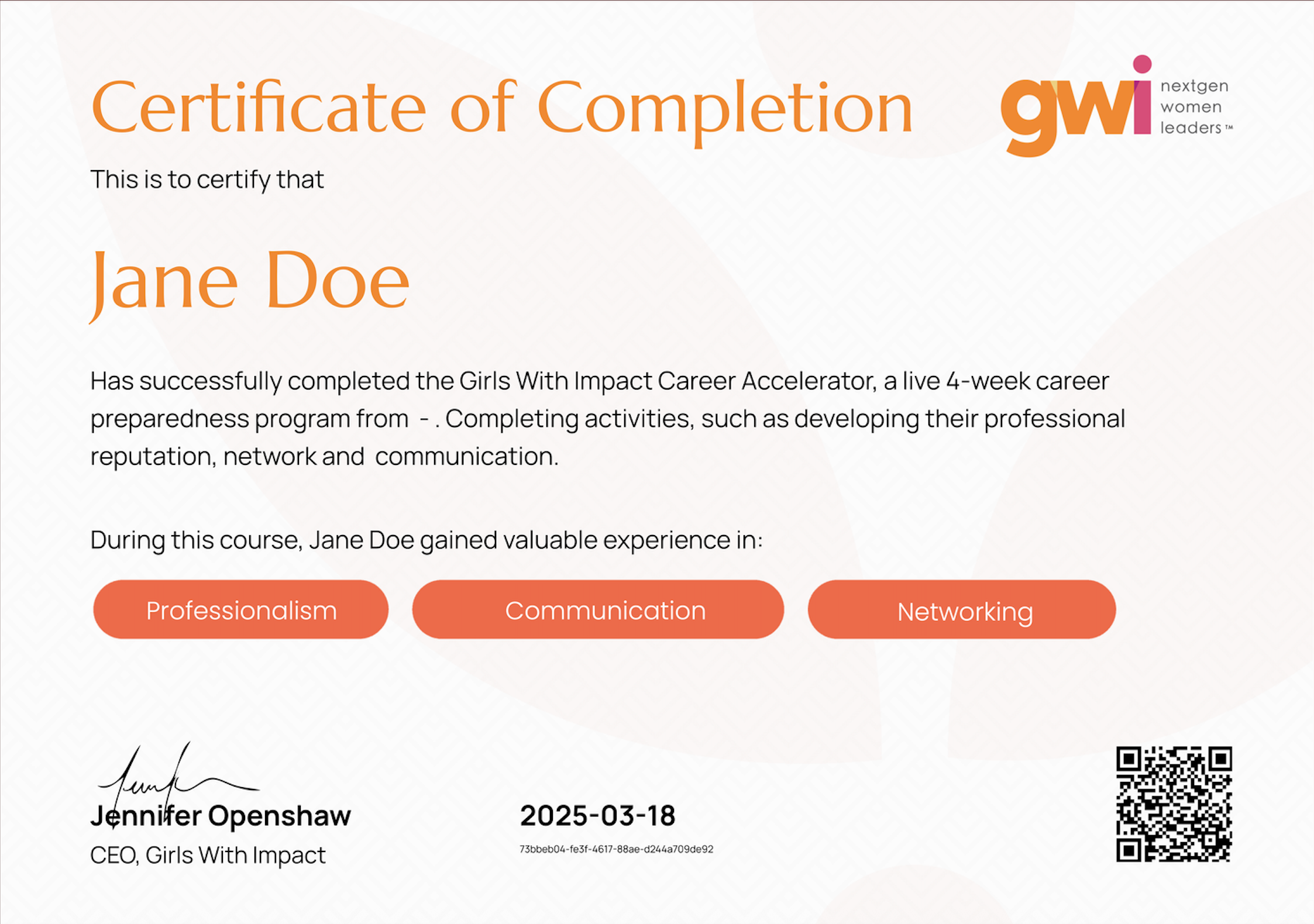
This is an example micro-credential from the Career Accelerator program. The Innovation Academy also awards a micro-credential upon successful completion.
“When I interviewed for my scholarship, all they wanted to hear about was my Girls With Impact experience,” GWI alum Rachel Motley said. Motley developed Crown Kits, style kits for Black Hair, and received over $200,000 in scholarships as a result of her involvement with Girls With Impact.
“I feel very inspired…before I didn’t know how to start my business off, so having guidance through Girls With Impact—I feel very capable right now.”
How Do I Include Leadership Experience on a Resume?
Another incredibly useful subheading for your resume is “Leadership Experience.” Employers are always looking to hire people who are confident and can take initiative or mobilize a group. Leadership does not always take the form of an official title (e.g., President, Vice President of a club), but rather can be demonstrated by anyone who takes action in a specific community. When explaining leadership experience on your resume some key words to begin your bullet point descriptions include facilitate, launch, coordinate, mentor, lead, direct, manage, spearhead, etc,. Active verbs will help signal a leadership role.
A great opportunity for high school students to build leadership skills is through the free Girls With Impact SheLeads program. By starting or joining a SheLeads chapter at their school, students are given the opportunity to practice their leadership and build their confidence within a supportive community. All instructional and guidance materials are provided by Girls With Impact, so the members can get started right away, and ensure the most out of their experience.
SheLeads, itself, is a resume-worthy activity. It is a regular commitment designed specifically to build professional skills, communication, and goals. As a member of GWI’s SheLeads clubs you are demonstrating a willingness to step up, take responsibility, and contribute to your community.
So, What Is a Resume Really?
In Latin resumere means “to take up again” or “to take back.” In French, résumé means “summary.” According to the Merriam-Webster dictionary, the English definition of resume is “a short account of one's career and qualifications.” No where in any of these etymologies does the word necessitate traditional, professional experience.
Rather, a resume is an opportunity to showcase all of your current or past involvements, interests, and skills at a bird’s eye view. It’s important to recognize the value of all life experiences, not just those that come with a paycheck.
The best advice is to start now. Keep a running resume with all of your commitments that you can work from and tailor to specific opportunities. It’s important to still keep a log of all of your commitments, though, because you might find unique lessons from unconventional places later down the line. You may realize that you’ve been working towards a professional pursuit just in some nonlinear, creative ways.
Are You Ready to Build Your Resume?
Then GWI's Innovation Academy and Career Accelerator programs are ready for you!
Learn more about the tangible takeaways, transferable skills, and micro-credentials available through these programs at: https://www.girlswithimpact.org/register
